Indie Development
Workflow

I then went in to Maya to do a basic block-out of my first/main level using simple polygons. Later on, after George's lecture on narrative structure, I knew that I wanted the game to lead the player visually from the get-go, with the player model being really small with something tall and impending in the background.
Creating a Game - Learning Unreal Engine and Blueprinting
We were asked to create a Game Prototype using simple mechanics implemented through UE4’s ‘Blueprint’. Gameplay had to feature a beginning and an end, with the first 10 seconds of play being engaging enough to entice the player further into the experience.
As a starting point I did some brief idea mapping and came up with the following pitch:
- You are a sentient piece of paper
- You roll around and clean up the streets by collecting rubbish
- Different materials get you different points
- Some are easy to find, some are hidden; a player must utilise jumping and platforming
- Collect a certain amount of rubbish to gain new abilities
- Goal: Clean the streets


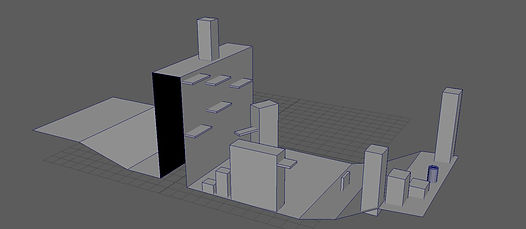


I sketched a rough path layout of where I wanted the player to go, based on leading the player.
Although I was happy with this basic block-out, I decided to incorporate something even taller and intimidating behind the original horizon.
Originally this was designed to be a tree, however this eventually becomes a skyscraper.

I also modeled some basic polygonal trees and a flower, but scrapped most of them for tree stumps instead.
When I imported my block-out in to UE4 it was extremely tiny, so I knew that I needed to up the scale of my models in Maya. I created 9 tree stump variations to use as decoration and platforms in my game.


In the end I decided to only keep one iteration of the short stumps and created slightly smoothed versions in Z-Brush, along with cages in Maya ready for baking.
I moved over to UE4 and began to create a block-out using the basic shapes available on the software. I used the pre-existing sky light for an easy set-up.

When I began to bake and paint my tree stumps it became clear quickly that I had failed to UV map any of them, so I went back in to Maya and UV mapped them all to prevent blocky & harsh breaks in textures.

I imported all of the lamberts and models in to the asset folder of my project and began to plug in the different texture maps by following SacMakersDaniel's tutorial on YouTube (https://www.youtube.com/watch?v=t-UQPPjZWAs)

The end result was great (ignoring one stump that had to be re-baked and painted) and was ready to implement them into my project.

I started replacing the cylinders with the stumps depending on their height, then varying them to create more visual diversity.

It is discussed that games can't be watched, read or listened to like other mediums can; they must be played, and active participation is necessary for the very structure of a game. With this considered, it can be argued that games are the only mass media that does more than just 'exist', where it doesn't matter whether an audience is present or not. For a game to reach completion, an active player must be engaged.

Later in the article, Aarseth considers who games studies really belongs to, if anyone, and how each existing field comments on it readily with their pre-existing paradigms, ignoring many of the unique,key aspects that make up a game. Varying scholars from different backgrounds fail to see the numerous and diverse differences between their own field and games studies, which is realistically an entirely unique genre of media in itself.
The quote-
"We have a billion dollar industry with almost no basic research".
shows contrast in how much information was publicly available on the work of authors and directors in comparison to data on games developers. Could this be why studios can come out with four amazing titles in a row only to release an absolute flop the following year?
Full version on 'Further Research' page.
Glossary:
- Paradigm: noun
-
a framework containing the basic assumptions, ways of thinking,and methodology that are commonly accepted by members of a scientific community.
-
such a cognitive framework shared by members of any discipline or group:
the company’s business paradigm.
- Integral: adjective
1. of, relating to, or belonging as a part of the whole; constituent or component:
integral parts.
2. necessary to the completeness of the whole: